Showing posts with label Trinity. Show all posts

Friday, September 20, 2024

Shall We Dance?: Considering an All-inclusive Worldview

This is my third blog post regarding worldviews. On July 30, I wrote (here) about the importance of expanding one’s worldview. The theme of my August 20 post was the sadness of shrinking one’s worldview. In this article, please consider the all-inclusive worldview (my term) presented by Jon Paul Sydnor in his 2024 book, The Great Open Dance: A Progressive Christian Theology.*1  

You may think it strange, but I never learned to dance. Growing up in a traditional Southern Baptist church, social dancing was frowned upon—and I didn’t have any trouble with that. In the last 20 years, though, I have read three theology books with “Dance” in the title.

The first of those was Molly Marshall’s 2003 book, Joining the Dance: A Theology of the Spirit. Seven years ago, I read Richard Rohr’s The Divine Dance: The Trinity and Your Transformation (2016). Then this month I finished reading Sydnor’s engaging new book.

These three books are largely, but not wholly, about the Christian concept of the Trinity, and all three authors write about the Greek word perichōrēsis, which I became aware of when reading Marshall’s book.

In 2022 (here), Rohr wrote, “Trinitarian theology says that God is a ‘circular’ rotation (perichoresis) of total outpouring and perfect receiving among three intimate partners.” That “circular rotation” is depicted as “the divine dance” in Rohr’s book noted above.*2

(I am quite sure that such “circular rotation” is quite different from the sexually stimulating social dancing that I have eschewed since my teenage years.)

The “great open dance” views all reality as being fully interrelated. Dance partners are obviously not one; they are separate selves. But they also are not two. Sydnor says the same is true for everything.

In interfaith discussions in Japan, my Japanese Buddhist friends sometimes talked about the term/concept funi (不二), which literally means not two. In his first chapter, Sydnor points out that “'not-two' refers to the unity-in-difference upon which our universe is based.” This is a nondual worldview.*3

Sydnor continues: “Nondualism asserts that all reality is inherently related.” Thus, “nondualism offers intellectual resistance to the false divisions that cause our suffering, implicitly condemning sexism, racism, classism, nationalism, … and every other divisive worldview.”

“The Persons of the Trinity Relate to One Another in a Divine Dance” is the title of one subjection in Sydnor’s first chapter. There he says, “When a skilled couple dances you cannot detect who is leading…. Their movements appear spontaneously generated.”

And so it is with the Trinity: “They [the ‘Persons’ of the Trinity] dance freely, spontaneously, always in relation to one another but never determined by one another, co-originating one another in joyful mutuality.”

This, then, leads to the central theme of the book: “We, being made in the image of God, are made to dance—with God, with one another, and with the cosmos.” This theme forms the basis for a worldview that is deeper and wider than most of us have—or have even thought of.

On this basis, Sydnor elucidates an all-inclusive worldview, one based on the perfect, unconditional, and universal love expressed by the Greek word agapé. Thus he asserts, “God is three persons united through agapic love into one nondual community. God is agapic nonduality.”

Sydnor acknowledges that “people want faith to give them more life, and people want faith to make society more just, and people want faith to grant the world more peace.” He then states that he has “written this book in the conviction that Trinitarian, agapic nondualism can do so.”

In his third chapter, Sydnor cites this foundational Bible verse: “There is one God and Creator of all, who is over all, who works through all and is within all” (Ephesians. 4:6, The Inclusive Bible, 2022). All here means, well, all, and that is the basis for Sydnor’s all-inclusive worldview.

Such a perspective is completely based on agape, “the unconditional, universal love of God for all creation.” These words of Sydnor in the first chapter lead to this statement in the ninth chapter: “What would society look like if its members truly trusted God and enacted the divine love? Certainly, it would be universalist.”

So, shall we dance, joining the great open dance of God and adopting a universal, all-inclusive worldview based on agapic nonduality? Sounds good to me.

_____

*1 I received a free copy of the e-book edition of Sydnor’s book from Mike Morrell and his Speakeasy website which provides “quality books in exchange for candid reviews.” This post is in partial fulfillment of that promise, but I am also publishing a review of the book on another blogsite (see here).

*2 As indicated on the cover of Rohr’s book, it was written “with Mike Morrell.”

*3 Funi is the Japanese translation of the Sanskrit words advaita in Hinduism and advaya in Buddhism. Sydnor is also the co-editor of (the very expensive) book, Nondualism: An Interreligious Exploration (2023) and the founding director of The Nondualism Project (click here to access their attractive website).

Friday, May 5, 2017

The Gospel According to "Eve"

Wm. Paul Young, as perhaps most of you know, is the author of The Shack (2008), which was made into a movie by the same name and released earlier this year. Some of you may also remember the blog article I posted on the book/movie back in March (see here). Then in April, I read Young’s 2015 novel, Eve.
A FANTASY NOVEL
Eve is classified as a Christian fantasy novel. For some reason, though, I have never cared much for fantasy books, Christian or otherwise. I have not read the highly acclaimed fantasy fiction of C.S. Lewis or J.R.R. Tolkien, although some of my children and grandchildren have greatly enjoyed their books of fantasy.  
An online dictionary defines fantasy as “the faculty or activity of imagining things, especially things that are impossible or improbable.” Maybe that is my problem: I just don’t have enough imagination to enjoy fantasy. At least that was my main problem in reading Eve.
Looking at the reviews of Eve on Goodreads.com was interesting (see here). Some readers gave it five stars and praised the book. Others gave it one star. One such person is Megz, a young white woman in South Africa. She is a fan of The Shack, she said, but then stated bluntly, “I don’t have a nice way of starting this review: I hated this book.”
I certainly didn’t hate it—but I had trouble appreciating the fantasy.
SOME FANTASTIC STATEMENTS
While I had trouble with much of the fantastic (= “imaginative or fanciful; remote from reality”) parts of the book, which was most of it, I was, nevertheless, impressed with some fantastic (= “extraordinarily good or attractive”) statements in it. Here are some examples.
Near the end of the book Eve says, “Perhaps this desire to reach out to the other [to Adam in her case], to make amends and repair loss, to build a bridge and heal, is a part of God’s maternal being that is in all of us” (p. 282).
One theme of the book is human freedom, which includes being able to make bad choices. In that regard, Eve says, “I have learned that God has more respect for me than I do for myself, that God submits to the choices I make, that my ability to say no and turn my face away is essential for Love to be Love.
Eve then goes on to state,
Adonai has never hidden His face from me, nor has He kept from me the consequences of my choosing. That is why many of my sons and my daughters curse the face and name of God. But God refuses to be like what we have become and take power and dominion. He has the audacity to consent and even submit to all our choosing. Then He joins us in the darkness we create because of all our turning (p. 283). 
A THEOLOGICAL NOVEL
There are some appealing theological aspects to Eve. As in The Shack, the feminine aspects of God, whom (because of his strong Trinitarian ideas) Young regularly refers to with plural pronouns, are highlighted. That maternal side of God is also portrayed as a part of all humans, made in the image of God.
God allows human freedom, as mentioned above, even when that leads to turning away from God. But they (God as the plural Trinity) still love unconditionally those who turn (sinners), and they are very eager to embrace all those who re-turn.
Another Goodreads reviewer, Rhonda in Virginia, wrote, “This book caused me to think deeply about my own brokenness.” Perhaps it also helped her, and others, to see the gospel (good news) according to Eve: God’s love is always available for the healing of every broken person.


Sunday, March 5, 2017

What about “The Shack”?

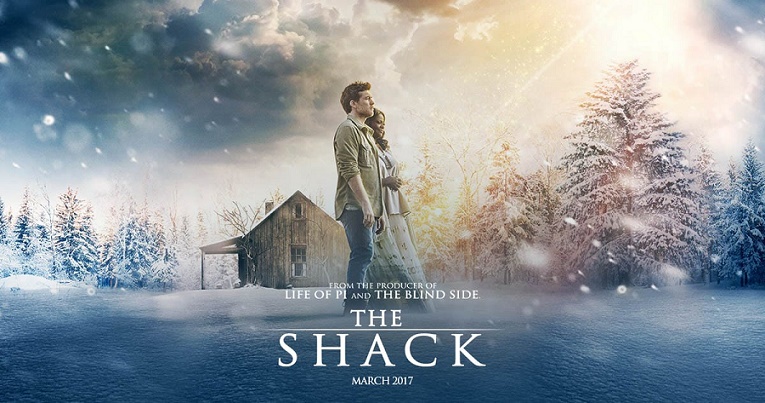
“An African-American, a Jew, and an Asian walk into a bar” might be the beginning of somebody’s joke. But Wm. Paul Young is dead serious when he centers his 2007 novel The Shack on three such persons—and this weekend the movie by the same name opened in theaters across the country. 
DESCRIBING “THE SHACK”
Young (b. 1955) is a Canadian novelist who self-published The Shack after his manuscript was turned down by 26 publishers. Remarkably, by June 2008 it had sold a million copies—and now sales are said to be over 25 million!

While definitely fiction, the book is also a theodicy, an argument for God’s goodness in the face of evil. Much of the book is response to Missy’s question about “how come [God’s] so mean?” (p. 33).

The book/movie is also a reflection on the nature of the Trinity. While clearly a temporary manifestation to Mack, the central human being in the book, God appears as Elousia, an African-American woman usually called “Papa”; Jesus, a Jewish carpenter; and Sarayu, a willowy Asian woman. 

When first meeting these three “persons,” Mack asks which one of them is God. “’I am,’ said all three in unison” (p. 89).
What a marvelous time, and what a healing time, Mack spends with this amazing Trinity!  

TRASHING “THE SHACK


There have been some very negative reviews of the book—mostly by conservative Christians. In 2010 Al Mohler, president of The Southern Baptist Theological Seminary, called it (here) “deeply troubling” and declared that it “includes undiluted heresy.”
Earlier, in May 2008, Charles Colson advised his readers (here), “Stay Out of The Shack.”
These are just two of many written criticisms of the theological content of The Shack. In addition, though, just about a year ago a 79-minute documentary film was produced with the title “The Shack: Its Dangerous Theology and Error.”
There are perhaps some legitimate concerns about the theology of the book—but the more conservative or traditional one is, the greater those concerns will likely be.
In addition to the conservative Christians who criticize the theology of The Shack, there are now many secular movie critics who trash the film.
Returning home after watching the movie, with delight, late Friday afternoon, I looked up some movie reviews of the film—and was disappointed in what I found. They were mostly negative—especially the one by Peter Sobczynski on RogerEbert.com. 
Perhaps “The Shack” is most appreciated/enjoyed by people with a moderate/liberal Christian worldview.
PRAISING “THE SHACK”
“When the imagination of a writer and the passion of a theologian cross-fertilize, the result is a novel on the order of The Shack. This book has the potential to do for our generation what John Bunyan’s Pilgrim’s Progress did for his. It’s that good!” 
These words, by Eugene Peterson (of The Message fame) are perhaps the most effusive in praising The Shack, but there have been numerous clerics and moderate to liberal Christian writers who have had positive words about it.
Many of you know and appreciate Richard Rohr. (I wrote about him, here, in Nov. 2015.) Last year Fr. Rohr published The Divine Dance: The Trinity and Your Transformation. I found it interesting that in this major book about the Trinity, Rohr had Young write the Foreword, mentions Young in the Introduction, and calls him a “dear brother” in the Acknowledgments. 
Except to my most (theologically) conservative and most secular friends, I highly recommend this delightful book/movie. It offers much to think about regarding the Triune God, dealing with grief, relationships (with God and other humans), as well as freedom of choice and the problem of evil.