Saturday, February 12, 2022

Isabel’s Testimony: The Power of Faith

In my March 25, 2021, blog post, I wrote briefly about Rachel (Clark) Seat, my great-grandmother. This article is about Great-grandma Rachel’s oldest daughter Isabel (also spelled Isabelle) and her strong faith expressed shortly before her death 132 years ago tomorrow, on February 13, 1890.

Introducing Isabel

Isabel Tempe Seat was born in rural Worth County, Missouri, on September 9, 1871. She was the first child of William and Rachel Seat, who had also been born in the same township.

When she was still 17, Isabel married Jake Williams, and before long they were expecting their first child. Leslie was born on January 25, 1890. But before three weeks had passed, his 18-year-old mother Isabel died of complications from childbirth.

Three days before her untimely death, a sizeable number of relatives and friends gathered around her deathbed where she repeatedly urged people to become Christian believers so that they would later be reunited in Heaven.

Isabel’s Testimony

A document titled “The Last Words of Isabel Williams” has been preserved in the Seat family. I don’t know who initially put those words in writing, but the first copy I saw was one made by Mary Rachel Seat, Isabel’s niece and my “wonderful aunt,” as I called her in my 6/25/16 blog post.

The first line of that document says, “Isabel Williams, while on her deathbed and there being several present, asked them to talk.” But actually, Isabel wanted to talk to them, and most of the document (which can be read in full here) are the words of testimony and entreaty given to many people.

I don’t know how so many people could have been present under one roof—and probably they were not all there at the same time—but Isabel called for them to come one or two at a time for her to speak to them from the depths of her Christian faith.

Her most often spoken words were, “Will you promise me you will meet me in Heaven?”—or words to that effect. And, evidently, many did make such a promise, including many who had not been Christian believers, or active Christians, at the time they heard Isabel’s question and plea to them.

Several of the people didn’t live close to New Hope Church where Isabel and her close family were members, so not long after her death, a new church was started—and given the name Isabelle Church. (It was about 3½ miles northeast of New Hope, a fair distance when traveling by horse and buggy.)

The Isabelle church building has been torn down in that sparsely populated part of northwest Missouri, but the cemetery is still there—and just a year and a half ago, J.W. Harding, a man I knew fairly well, was buried there. The picture below (taken several years ago) is of the entrance to the cemetery.  

Isabel’s Faith

Isabel’s belief/certainty about going to Heaven after death was not at all unusual for someone living when and where she did—although perhaps it was a bit unusual for someone only 18 years old to express that faith so strongly.

Isabel’s parents lived within easy walking distance from New Hope Church after it was constructed in 1877-78, and she, no doubt, attended services every Sunday morning and evening with her mother during her girlhood years. (Isabel’s father, sadly, died in 1880 on Isabel’s ninth birthday.)

My previous blog post was partly about common sense, and I asserted that “common sense” can be called that only for those who see the world through the same, or quite similar, “conceptual lenses.”

The conceptual lenses of most people in Worth County, Mo., in 1890 were those fashioned by evangelical Protestant Christians. While certainly everyone was not a professing or active Christian believer, Christianity as understood by Baptists and other evangelicals was the dominant culture.

Certainly, there were many things about Christianity that Isabel still needed to learn—but who can say that her faith that she expressed so powerfully was wrong?

Isabel’s faith was, without doubt, highly comforting to her. But who can say, and on what basis, that her powerful Christian faith wasn’t also basically true?

Tuesday, February 8, 2022

Considering Common Sense: In Memory of Thomas Paine

For most of my life, I have known the name Thomas Paine. But also for most of my life, I have known little about him and his importance. This month, however, seemed like a good time to learn/think a little more about Paine, who was born 285 years ago, and about his emphasis on common sense. 

Who Was Thomas Paine?

Paine was born in England in 1737 on January 29, which was February 9 according to the “new style” calendar used after 1752.

After losing his wife and baby at childbirth in 1760, and then after various failures and the loss of his job in 1774, he moved to Philadelphia and got a job working as an editorial assistant for the Pennsylvania Magazine.

After the first battles of the Revolutionary War in 1775, Paine argued that the colonists should not simply revolt against taxation but demand independence from Great Britain entirely. He expanded that idea in a 50-page pamphlet called “Common Sense,” printed in January 1776.

Why Is Thomas Paine Memorable?

Within a few months after its publication, “Common Sense” sold more than 500,000 copies, and according to Biography.com (here), more than any other publication, it “paved the way for the Declaration of Independence, which was unanimously ratified on July 4, 1776.”

Then beginning in December of that year, a most uncertain time regarding the outcome of the revolution, Paine began publishing a series of pamphlets under the title The American Crisis, and he signed them with his pseudonym, “Common Sense.”

The first of those thirteen pamphlets famously begins, “These are the times that try men’s souls.” At the beginning of that harsh winter of 1776, a great many soldiers were ready to quit—until ordered by General Washington to read Paine’s Crisis (which can be read in full at this link).

The morale of the American colonists was bolstered and their resolve fortified by Paine’s words, “Tyranny, like hell, is not easily conquered, yet we have this consolation with us, that the harder the conflict, the more glorious the triumph.

In 1787, Paine returned to England, and two years after the beginning of the French Revolution in 1789, he wrote The Rights of Man. That tract moved beyond supporting that revolution to discussing the basic reasons for the widespread discontent in Europe and railing against an aristocratic society.

Paine’s last major book was The Age of Reason: Being an Investigation of True and Fabulous Theology, the first part of which was written in 1794 after he had been imprisoned for nearly a year in France.

Paine returned to the United States in 1802 or ’03, but by then his influential revolutionary work had mostly been forgotten. He died in 1809, and only six mourners were present at his funeral.

Because of his last book, though, he became known in the mid-nineteenth century as a leader of “freethinkers.” And then in the early twentieth century, Paine's reputation was restored and he again was (accurately) viewed as a vital figure in the American Revolution.

What Is Common Sense?

“Common sense” can be called that only for those who see the world through the same, or quite similar, “conceptual lenses.”

What Paine wrote about common sense for those who wanted to be free from the “tyranny” of England was, truly, common sense for them. But it certainly was not common sense for King George and all the Redcoats who fought for him.

And so it is regarding many burning issues today.

You would think it is only common sense that everyone would get covid-19 vaccinations and only common sense for the government to mandate vaccines and masks in order to control the spread of covid-19.

But, alas, a sizeable portion of society wears different conceptual lenses: they see the greatest good as personal “freedom” and oppose “tyrannical” governments they see as seeking to usurp that freedom. Even a “Christian” organization is used to support the “Freedom Convoy” in Canada (see here).

And you would think it is only common sense that we humans would acknowledge the seriousness of global warming and take even drastic measures to mitigate the coming environmental crisis. But, again, alas! 

Thursday, February 3, 2022

Is There a “World without End”?

Since watching several of Michael Dowd’s videos last month (and writing a bit about Dowd on Jan. 25) I have been thinking much about the end of the world as we know it—and about the traditional Christian belief in a “world without end.” Is it possible to affirm both?

The Traditional Christian Belief

There is little doubt that from New Testament times until the present Christianity has asserted a firm belief in a “world without end,” that is, the reality of an eternal world that in every way surpasses the present physical world in which we now live.

The New Testament says, “Unto [God] be glory in the church by Christ Jesus throughout all ages, world without end. Amen” (Ephesians 3:21, KJV). Based on these words, the Catholic and some liturgical Protestant churches regularly sing the Gloria Patri doxology: 

As the “world without end” is understood as the abode of those who have received the gift of eternal life, the Apostles’ Creed ends with words affirming belief in “the resurrection of the body, and the life everlasting.”

And the Nicene Creed, which is also regularly repeated in public worship services of many churches, ends with these words: “We look for the resurrection of the dead and the life of the world to come. Amen.

Even those of us who grew up in non-liturgical churches, belief in “eternal life” and Heaven was central to our understanding of the Christian faith. But that basic belief seems to have been weakened, neglected, or even denied (in practice if not in words) by “progressive” or “liberal” forms of the faith.

For example, in spite of his dire prognostication about the coming ecological crisis that will most likely result in the end of the world as we know it, Dowd, an ordained Christian minister, says nothing (at least that I have heard) about even the possibility of life beyond death.

The Problem of “Evangelical” Over-emphasis

Those who grew up in conservative evangelical circles, as I did, know how strong the emphasis was on “soul-winning,” that is, getting people “saved” so they would go to Heaven when they died.

During my boyhood years, pastors and especially traveling evangelists would regularly emphasize the Second Coming of Jesus and the concomitant end of this present world, focusing on the reality of “the world without end.”

These same emphases became even more pronounced in conservative evangelical churches after the publishing of Hal Lindsey’s bestselling book The Late Great Planet Earth in 1970.

And then from 1995 to 2007, the Left Behind series of sixteen books by Tim LaHaye and Jerry B. Jenkins was highly popular and influential in evangelical circles.

But all of this emphasis on the “end times” was usually accompanied by a marked lack of interest in the plight of people living in the world now. Hardly any emphasis was placed on social issues such as war, systemic racism, poverty, destruction of the environment, etc.

The Problem of “Liberal” Under-emphasis

Although the roots go back much farther into the past, from the 1960s on “progressive” or “liberal” Christians placed more and more emphasis on the social issues of the present world and less and less emphasis on the idea/hope of a coming world without end.

The apocalyptic ideas/beliefs of the conservative evangelicals were mostly ignored, or even scoffed at by many liberals. Of primary interest and importance was the formation of a “beloved community” here and now and being on the right side of the arc of the universe which bends toward justice.

The coming of an ideal society, the Kingdom (or Kindom) of God, was a strong hope for the future of humankind on this earth.

How utterly sad it is if, as Dowd and many liberal Christians (as well as most people without any religious faith) acknowledge, all we can do now is to serenely accept the coming demise of the world with no hope for the future either on this earth or in a world without end.

Is there not some radiant center position between the two extremes?

Saturday, January 29, 2022

A Longer Look at the Serenity Prayer

In my previous blog post, I recommended watching Michael Dowd’s 25-minute YouTube video titled “Serenity Prayer for the 21st Century.” Since watching that video a couple of weeks ago, I have been thinking more about the serenity prayer and I invite you, too, to take a longer look at it.

Looking at the Serenity Prayer

In its shortest form, the serenity prayer consists of three simple petitions, artistically presented as follows: 

As you probably know, the serenity prayer is the Alcoholics Anonymous (AA) prayer recited at the end of each AA meeting.

AA.com also has a link to a 12-page pdf titled “Origin of The Serenity Prayer: A Historical Paper.” In spite of similar statements made by various people, the conclusion is that American theologian Reinhold Niebuhr (1892~1971) penned the prayer in its present form.

Even though Niebuhr’s prayer is universally known as the serenity prayer, it actually includes petitions for three things: serenity, courage, and wisdom. It is also noteworthy that serenity is linked to acceptance. Denying or struggling against the inevitable always destroys serenity.

This prayer, though, asks God for courage and wisdom as well as serenity, so perhaps it should be called the serenity/courage/wisdom prayer. Indeed, Niebuhr’s main intent may well have been a call to courageous action, rather than a serenity that fails to work for necessary changes in society.

Looking at the Longer Serenity Prayer

In the above-mentioned video, Dowd emphasizes the next three lines of the serenity prayer that, he says, a lot of people don’t know:

Living one day at a time;
Enjoying one moment at a time;
Accepting hardships as the pathway to peace,

These are good words. Regardless of what we have faced in the past or are going to face in the future, living and enjoying one day/moment at a time is truly the pathway to personal peace.

Those words of Niebuhr written in the early 1940s are similar to the emphasis on mindfulness by Thích Nhất Hạnh, the venerable Vietnamese Buddhist monk who died on January 22. He taught,

When we are mindful, deeply in touch with the present moment, our understanding of what is going on deepens, and we begin to be filled with acceptance, joy, peace and love.

These words by Thích Nhất Hạnh, as well as the three lines in the serenity prayer that are not widely known, do nothing to help solve the crisis of global warming or the likely collapse of industrial civilization. But they do help us to live calmly and at peace in spite of looming crises.

Looking at the Longer Serenity Prayer

The longest version of the serenity prayer as given on the website of Alcoholics Anonymous (and elsewhere) includes all of the lines cited above followed by these words:

Taking, as He did, this sinful world
As it is, not as I would have it;
Trusting that He will make things right
If I surrender to His will;
So that I may be reasonably happy in this life
And supremely happy with Him
Forever and ever in the next.
Amen.

These final lines of the serenity prayer regularly spoken by AA members are even less widely known than the three lines mentioned in the previous section—and are not mentioned by Dowd at all.

What does it mean to be “supremely happy with Him [God] forever and ever in the “next” life? And how come Dowd, an ordained Christian minister, didn’t mention these words at all?

From New Testament times on, Christians have affirmed the reality of a coming “world without end.” Why is that emphasized so little in so much of contemporary Christianity? This is what I will continue to ponder as I prepare my next blog posting. 

Tuesday, January 25, 2022

Facing the Grief of Looking Up, Looking Forward

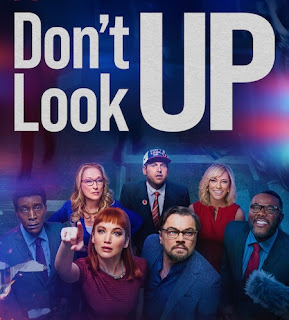
Don’t Look Up has been a much-viewed, much-discussed movie this month. There has been a wide variety of comments about that Netflix film both by “professional” movie critics and by amateur reviewers (like me). Unlike some of the professionals, though, I think it was quite significant. 

The Grief of Looking Up

Don’t Look Up is ostensibly about a huge (the size of Mount Everest) comet which is on track to crash into the earth about six months after when it was discovered by a grad student at Michigan State University. She and her professor seek to warn the world of the coming disaster.

Their message of impending doom, however, is not well received. The media is more concerned with the latest news about celebrities and the President is more concerned with the upcoming election and the breaking news about her own personal scandal.

Additionally, wealthy capitalists seek to take advantage of the looming catastrophe for economic gains. And then soon numerous science (comet) deniers emerge, rallying under the cry “Don’t look up!”

Even though that is what the film is about on the surface, it was produced as a satire about the current crisis of climate change (better labeled as global warming).

A large segment of society—politicians, capitalists, media personalities, and many of the general public—is like the science deniers in the film, but their rallying cry for maintaining the unsustainable present is “Don’t look forward.”

The Grief of Looking Forward

In the past couple of weeks, I have learned of, and been challenged/shaken by, Michael Dowd. A constantly evolving thinker, Dowd (b. 1958) is an American progressive Christian minister (ordained by the UCC) and an “eco-theologian.”

His recent work has been focused on the worldwide ecological crisis, which he is certain will lead to TEOTWAWKI (the end of the world as we know it).

My initial introduction to Dowd’s alarming thought was through two thirty-minute YouTube videos produced in November 2021: “Collapse in a Nutshell” and “Overshoot in a Nutshell,” both having the subtitle “Understanding Our Predicament.”

In addition, I watched (and recommend) Dowd’s 25-minute video, “Serenity Prayer for the 21st Century: Pro-Future Love-in-Action,” produced in June 2021. According to Dowd, “the serenity to accept the things I cannot change” includes, or is primarily, TEOTWAWKI.

I have many questions and reservations about Dowd’s disturbing message, but what he presents is certainly something that all of us critical thinkers must take seriously—and his suggestions on how to deal with the grief of looking forward may well be very valuable for us all.

So, What Should We Do?

Whether Dowd’s dire analysis is completely correct or not, of greatest importance is to realize as fully as possible that the ecological crisis is much more critical than most people, probably including most of us, have acknowledged.

The result of unchecked global warming is not just one problem among many equally serious social problems. Indeed, it is not a problem that will likely be solved; rather it is a predicament from which there is likely no escape.

If humankind, probably in this century, will likely experience a collapse of civilization as we know it, what should we do? Dowd’s advice is to work through the stages of grief, accepting what is most probably inevitable, but still living each day with joy and thankfulness in spite of the looming doom.

He emphasizes the need for “adaptive inattention” to the crisis, seeking the well-being of people now. We can seek to be agents of calm amidst the coming chaos.

While the film Don’t Look Up doesn’t deal directly with the grief of looking forward, the final prayer at the “last supper” of several of the characters in the movie is a good one for us to pray at this critical time:

Dearest Father and Almighty Creator, we ask for your grace tonight, despite our pride; your forgiveness, despite our doubt. Most of all Lord, we ask for your love to soothe us through these dark times. May we face whatever is to come in your divine will, with courage and open hearts of acceptance. Amen.

_____

** Even though he is an ordained Christian minister, Dowd says nothing about what Christians have affirmed for 2,000 years: the coming of a “world without end.” I am planning for my first blog post in February to be about that.

Thursday, January 20, 2022

Do Hope and History Rhyme? Assessing Biden’s First Year

It’s been a hard year since January 20, 2021, the day Joe Biden was inaugurated as the 46th POTUS—and it has been a harder year for him than for most of us. What can be said, fairly and honestly, in assessment of Biden’s first year in the White House? 

1/7/22 image by Mandel Ngan

Biden’s Quote from Seamus Heaney

The President is said to be five-eighths Irish and has spoken frequently of his family ties to Ireland. He also likes Irish poets, especially Seamus Heaney (1939~2013), who was awarded the 1995 Nobel Prize in Literature.

In his inaugural speech a year ago today, the new President cited these words from Heaney’s poem “The Cure of Troy”:

History says, Don’t hope
On this side of the grave…
But then, once in a lifetime
The longed-for tidal wave
Of justice can rise up,
And hope and history rhyme.

These are memorable words, and Biden quoted them with great sincerity (and you can hear him read those words here), but one year later it seems as though the hopes of the President are far from rhyming with history now.

Biden’s Hard Year

As is true of each new President, except perhaps for #45, they start their term in office with high hopes for what they want to accomplish for the good of the nation. But those hopes are seldom realized (thus, history says, Don’t hope).

Perhaps the last President to have come close to realizing his inaugural hopes was FDR. Especially during the first two terms of his presidency (1933~1941), hope and history did rhyme to a large extent.

Roosevelt’s third inaugural address, though, delivered 80 years to the day before Biden’s address last year, was a lifetime ago. Few remember those remarks stressing America’s obligation to take action during the international crisis. Those next 4+ years were especially hard for FDR.

But for Biden, the first year has been a hard one:

* The covid-19 pandemic, with its new variants and the widespread refusal of being vaccinated, worsened instead of dissipating.

* Largely related to disruptions caused by covid-19, inflation grew rapidly and consumer prices increased perceptibly.

* Because of the intransigence of all 50 Republican and of two Democratic Senators, a democracy-protecting voting rights bill and an expansive infrastructure bill both failed to gain the support necessary for enactment.

* The events surrounding the withdrawal of U.S. troops in Afghanistan were widely criticized as Biden’s debacle.

* The Jan. 15 issue of The Economist states that Biden is “almost the most unpopular president since records began” (only Trump “rated worse” at the same point in his term). Accordingly, “a mid-terms shellacking for his party looks highly probable.”

Biden’s Hope in the Year(s) Ahead

One year doesn’t make or break a presidency. In spite of the setbacks and disappointments, there are first-year accomplishments that the President and his party can legitimately accentuate in the year ahead.

* The early rollout of vaccines was highly successful. (It was certainly not Biden’s fault that so many people, mostly Republicans, refused to get vaccinated—or that new variants, delta and then omicron, developed.)

* Early in his tenure Biden also won passage for a roughly $2 trillion stimulus package and followed that with enactment of a $1.2 trillion infrastructure bill with bipartisan support.

* Also, as Heather Cox Richardson points out, last February the jobless rate was 6.2%; today it has dropped to 4.2%. This means the Biden administration has created 4.1 million jobs, more than were created in the 12 years of the Trump and George W. Bush administrations combined.**

* Further, according to a 12/20/21 Bloomberg News article, “America’s economy improved more in Joe Biden's first 12 months than any president during the past 50 years . . . “ The S&P 500 gained 26.9% and Dow Jones gained 18.7% in 2021.

Perhaps if the President stays the course and “soldiers on,” as James Carville admonished him to do this week on Meet the Press, the longed-for tidal wave of justice will yet rise up, and hope and history will begin to rhyme more and more.

_____

** This, and much more about Biden’s first year accomplishments, is found in Richardson’s 12/22/21 “letter” (see here).

Saturday, January 15, 2022

Thankful for Social Security

You probably have never heard of a fellow named Ernest Ackerman, but he was the first person in the U.S. to receive Social Security benefits. That was in January 1937—and he received 17 cents! But that was a good return: he had been a member for just one day and had contributed only five cents. 

Creation of Social Security

The Social Security Administration has an online 40-page document titled “Historical Background And Development Of Social Security.” For those who want (and have the time to read!) detailed information, that is the place to go. Here I will just write briefly about the years from 1933 to 1940.

There had long been a dire need in this country for financial help for the elderly. One of the most popular plans before 1935 was the Townsend Plan as proposed by Francis Townsend (b. 1/13/1867).

In 1933, Townsend launched his career as an old-age activist, proposing that every retired person over 60 be paid $200 per month—with the stipulation that they had to spend the money within 30 days (to stimulate the economy).

Within two years, there were over 3,400 Townsend Plan Clubs in the U.S. Their popularity prompted FDR to propose Social Security and then spurred Congress to pass the Social Security Act (SSA), which President Roosevelt signed into law in August 1935.**

Taxes were collected for the first time 85 years ago this month, in January 1937, including Ackerman’s nickel. However, the first monthly retirement check was not issued until January 31, 1940. That check was sent to Ida May Fuller of Ludlow, Vermont, and was for $22.54.

Opposition to Social Security

As you might well guess, there was considerable opposition to the SSA of 1935 as there was to most of FDR’s New Deal proposals. From the very beginning, one of the main arguments against Social Security was that it was a form of socialism. 

But by 1936 economic conditions in the U.S. had improved considerably and Roosevelt was widely popular. So, in spite of the opposition to the New Deal by Republicans and criticism of Social Security as being socialist, Roosevelt was re-elected by a landslide.

In July 1965, under the leadership of President Johnson, Congress enacted Medicare under Title XVIII of the Social Security Act to provide health insurance to people aged 65 and older, regardless of income or medical history. 

Opposition to the federal government passing legislation for the benefit of the general public increased after 1981, with President Reagan declaring in his inaugural address “. . . government is not the solution to our problem; government is the problem.” 

Conservative Republicans ever since have consistently used Reagan’s words and their opposition to socialism to oppose greater levels of healthcare, such as their unified opposition to “Obamacare” in 2010, and some even wanting to alter or dismantle Social Security.

Gratitude for Social Security

Millions and millions of USAmericans (including me), though, are deeply grateful for Social Security and Medicare. And for the benefit of a wider public, many (again, including me) are in full support of expanding Medicare and “Obamacare,” which has steadily gained in popularity.

A 2019 Gallup poll indicated that “Social Security is a mainstay of older Americans’ financial wherewithal, and . . . a system Americans greatly value.”

The same article reports that some 57% of retirees indicated that Social Security is a major source of income in their retirement, eclipsing by far the second and third sources—retirement accounts such as 401(k)s and IRAs, and work-sponsored pension plans.

Similarly, Medicare/Medicaid also has widespread public support, and a strong majority now believe that those benefits should be expanded.

And then according to a Kaiser Family Foundation poll in Oct. 2021, nearly 60% of all U.S. adults approved of “Obamacare,” the highest percentage of approval since its beginning. It was opposed, though, by 72% of the Republicans polled.

But yes, along with so many others I have great gratitude for Social Security (and Medicare) which has provided so much financial help through the years since June and I turned 65.

_____

** Here is the link to Heather Cox Richardson’s informative four-page “letter” posted on Aug. 14, 2021, the anniversary of Roosevelt’s signing the SSA into law. It is partly about Francis Townsend, but has more about Frances Perkins, FDR’s Secretary of Labor.