Showing posts with label eschatology. Show all posts

Thursday, February 3, 2022

Is There a “World without End”?

Since watching several of Michael Dowd’s videos last month (and writing a bit about Dowd on Jan. 25) I have been thinking much about the end of the world as we know it—and about the traditional Christian belief in a “world without end.” Is it possible to affirm both?

The Traditional Christian Belief

There is little doubt that from New Testament times until the present Christianity has asserted a firm belief in a “world without end,” that is, the reality of an eternal world that in every way surpasses the present physical world in which we now live.

The New Testament says, “Unto [God] be glory in the church by Christ Jesus throughout all ages, world without end. Amen” (Ephesians 3:21, KJV). Based on these words, the Catholic and some liturgical Protestant churches regularly sing the Gloria Patri doxology: 

As the “world without end” is understood as the abode of those who have received the gift of eternal life, the Apostles’ Creed ends with words affirming belief in “the resurrection of the body, and the life everlasting.”

And the Nicene Creed, which is also regularly repeated in public worship services of many churches, ends with these words: “We look for the resurrection of the dead and the life of the world to come. Amen.

Even those of us who grew up in non-liturgical churches, belief in “eternal life” and Heaven was central to our understanding of the Christian faith. But that basic belief seems to have been weakened, neglected, or even denied (in practice if not in words) by “progressive” or “liberal” forms of the faith.

For example, in spite of his dire prognostication about the coming ecological crisis that will most likely result in the end of the world as we know it, Dowd, an ordained Christian minister, says nothing (at least that I have heard) about even the possibility of life beyond death.

The Problem of “Evangelical” Over-emphasis

Those who grew up in conservative evangelical circles, as I did, know how strong the emphasis was on “soul-winning,” that is, getting people “saved” so they would go to Heaven when they died.

During my boyhood years, pastors and especially traveling evangelists would regularly emphasize the Second Coming of Jesus and the concomitant end of this present world, focusing on the reality of “the world without end.”

These same emphases became even more pronounced in conservative evangelical churches after the publishing of Hal Lindsey’s bestselling book The Late Great Planet Earth in 1970.

And then from 1995 to 2007, the Left Behind series of sixteen books by Tim LaHaye and Jerry B. Jenkins was highly popular and influential in evangelical circles.

But all of this emphasis on the “end times” was usually accompanied by a marked lack of interest in the plight of people living in the world now. Hardly any emphasis was placed on social issues such as war, systemic racism, poverty, destruction of the environment, etc.

The Problem of “Liberal” Under-emphasis

Although the roots go back much farther into the past, from the 1960s on “progressive” or “liberal” Christians placed more and more emphasis on the social issues of the present world and less and less emphasis on the idea/hope of a coming world without end.

The apocalyptic ideas/beliefs of the conservative evangelicals were mostly ignored, or even scoffed at by many liberals. Of primary interest and importance was the formation of a “beloved community” here and now and being on the right side of the arc of the universe which bends toward justice.

The coming of an ideal society, the Kingdom (or Kindom) of God, was a strong hope for the future of humankind on this earth.

How utterly sad it is if, as Dowd and many liberal Christians (as well as most people without any religious faith) acknowledge, all we can do now is to serenely accept the coming demise of the world with no hope for the future either on this earth or in a world without end.

Is there not some radiant center position between the two extremes?

Tuesday, January 25, 2022

Facing the Grief of Looking Up, Looking Forward

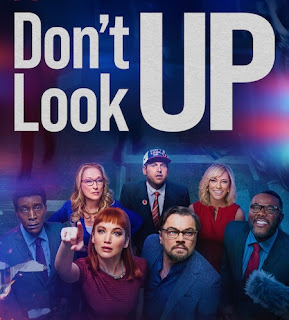
Don’t Look Up has been a much-viewed, much-discussed movie this month. There has been a wide variety of comments about that Netflix film both by “professional” movie critics and by amateur reviewers (like me). Unlike some of the professionals, though, I think it was quite significant. 

The Grief of Looking Up

Don’t Look Up is ostensibly about a huge (the size of Mount Everest) comet which is on track to crash into the earth about six months after when it was discovered by a grad student at Michigan State University. She and her professor seek to warn the world of the coming disaster.

Their message of impending doom, however, is not well received. The media is more concerned with the latest news about celebrities and the President is more concerned with the upcoming election and the breaking news about her own personal scandal.

Additionally, wealthy capitalists seek to take advantage of the looming catastrophe for economic gains. And then soon numerous science (comet) deniers emerge, rallying under the cry “Don’t look up!”

Even though that is what the film is about on the surface, it was produced as a satire about the current crisis of climate change (better labeled as global warming).

A large segment of society—politicians, capitalists, media personalities, and many of the general public—is like the science deniers in the film, but their rallying cry for maintaining the unsustainable present is “Don’t look forward.”

The Grief of Looking Forward

In the past couple of weeks, I have learned of, and been challenged/shaken by, Michael Dowd. A constantly evolving thinker, Dowd (b. 1958) is an American progressive Christian minister (ordained by the UCC) and an “eco-theologian.”

His recent work has been focused on the worldwide ecological crisis, which he is certain will lead to TEOTWAWKI (the end of the world as we know it).

My initial introduction to Dowd’s alarming thought was through two thirty-minute YouTube videos produced in November 2021: “Collapse in a Nutshell” and “Overshoot in a Nutshell,” both having the subtitle “Understanding Our Predicament.”

In addition, I watched (and recommend) Dowd’s 25-minute video, “Serenity Prayer for the 21st Century: Pro-Future Love-in-Action,” produced in June 2021. According to Dowd, “the serenity to accept the things I cannot change” includes, or is primarily, TEOTWAWKI.

I have many questions and reservations about Dowd’s disturbing message, but what he presents is certainly something that all of us critical thinkers must take seriously—and his suggestions on how to deal with the grief of looking forward may well be very valuable for us all.

So, What Should We Do?

Whether Dowd’s dire analysis is completely correct or not, of greatest importance is to realize as fully as possible that the ecological crisis is much more critical than most people, probably including most of us, have acknowledged.

The result of unchecked global warming is not just one problem among many equally serious social problems. Indeed, it is not a problem that will likely be solved; rather it is a predicament from which there is likely no escape.

If humankind, probably in this century, will likely experience a collapse of civilization as we know it, what should we do? Dowd’s advice is to work through the stages of grief, accepting what is most probably inevitable, but still living each day with joy and thankfulness in spite of the looming doom.

He emphasizes the need for “adaptive inattention” to the crisis, seeking the well-being of people now. We can seek to be agents of calm amidst the coming chaos.

While the film Don’t Look Up doesn’t deal directly with the grief of looking forward, the final prayer at the “last supper” of several of the characters in the movie is a good one for us to pray at this critical time:

Dearest Father and Almighty Creator, we ask for your grace tonight, despite our pride; your forgiveness, despite our doubt. Most of all Lord, we ask for your love to soothe us through these dark times. May we face whatever is to come in your divine will, with courage and open hearts of acceptance. Amen.

_____

** Even though he is an ordained Christian minister, Dowd says nothing about what Christians have affirmed for 2,000 years: the coming of a “world without end.” I am planning for my first blog post in February to be about that.

Thursday, November 30, 2017

Is Wright Right?

N.T. Wright is an eminent British New Testament scholar whom I have respected for many years. How God Became King: The Forgotten Story of the Gospels (2012) is one his many books. It is mainly about the central message of the four gospels in the New Testament.
What Are the Gospels About?
As Wright (b. 12/1/1948) explains in the Preface, “the story that the four evangelists tell is the story, as in my title, of ‘how God became king’.”
Early in the book, he notes that Protestant Christianity has assumed atonement and justification “to be at the heart of ‘the gospel.’ But,” he insists, the gospels—Matthew, Mark, Luke, and John—“appear to have almost nothing to say about those subjects” (p. 6).
Further, the classic Christian creeds say little about the bulk of the four gospels: They “were all about God becoming king, but the creeds are focused on Jesus being God” (p. 20).
So, again, Wright clearly asserts that “the whole point of the gospels is to tell the story of how God became king, on earth as in heaven” (p. 34).
I think that basically Wright is right in what he writes here. 
Where is the Kingdom of God?
Conservative/evangelical Christians have long emphasized that the Kingdom of God (KoG) will come into fruition at the end of the present world. It is seen primarily as being in Heaven following the end times.
Partly because the KoG is always called “kingdom of heaven” in Matthew’s gospel (beginning with Mt. 3:2), it has commonly been viewed as “other-worldly” and primarily about the future rather than the present.
However, there has been a growing recognition among liberal, moderate, and even left-wing evangelical Christians that the KoG is about the here and now as well as about “the sweet by and by.” This new understanding is based partly on the Lord’s Prayer for God’s will to be done “on earth as it is in heaven.”
As I wrote in my Feb. 28 blog article, through the years I have come to understand that the KoG is as much about, or even more about, God’s reign on earth now than after the “end of the world.”
Indeed, if God became King in and through Jesus’ death and resurrection, as Wright writes, then the KoG is here and the KoG is now.
This basic understanding is also found in the recent writings of popular Christian authors such as Brian McLaren as well as in the books of Brian Zahnd, such as Sinners in the Hands of a Loving God (2017), which I wrote about on Sept. 5 (see here). (Both McLaren and Zahnd hold Wright in high regard.)
Why Doesn’t It Look Like God is King?
The perplexing question, of course, is why, if God is King, doesn’t the world look more like what we would expect God’s Kingdom to look like? Please consider these brief suggestions:
1) There was no promise that the full realization of the KoG would come quickly—and considering the age of the universe or the history of Homo sapiens, what is a mere 2,000 years?
2) The KoG is being established, slowly, only by peaceful means and without coercion. Every use of coercion by Christians, and there have been a multitude of attempts to expand the KoG by force—has caused a setback.
3) There has been progress—although the struggle continues. As Wright acknowledges, “the story of Jesus” is seen in the New Testament “as the clash between the kingdom of God and the kingdoms of the world” (p. 138).
So we continue to pray, “Your Kingdom come”—while both working and waiting for that to happen.

Wednesday, March 25, 2015

Do You Believe in the Rapture?

In an earlier blog article this month, I mentioned having a theological discussion with my sister. One of the direct questions she asked me was, “Do you believe in the Rapture?”
If she had asked me that question 60 years ago in 1955, which was the year I graduated from high school and the year after I started preaching, I most probably would have answered Yes without hesitation. But now I had to say, “No, I do not believe there will be a literal Rapture.”
My sister, just like some other family members and friends who hold to a fairly literal interpretation of the Bible, likely thinks her unchanging view of the Bible and theology means she is upholding “the faith which was once for all delivered to the saints” (Jude 1:3).
The Rapture is considered very important by conservative Christians—and not believing in the Rapture is considered a serious matter. In his bestselling book “Four Blood Moons” (2013), John Hagee declares that “false prophets are now teaching there will be no Rapture of the church” (p. 76).
Hagee (b. 1940) also gives this grave warning: “If you are deceived into believing there is no Rapture, prepare to stand in line to get your personal tattoo from the Antichrist” (p. 79).
And then a little later, Hagee, who is the founder and senior pastor of Cornerstone Church in San Antonio, Texas, asserts, “Satan hates the Rapture teaching and has his deluded disciples saying there will be no Rapture” (p. 83).

There is not enough space in a 600-word article to explain all the reasons why I no longer affirm a literal Rapture. But the linking of Rapture theology to current world affairs is one reason for not only denying the Rapture as taught by Hagee and many others but for also seeing it as a dangerous teaching.
Back as far as 2010 Hagee was calling for the U.S. to join with Israel in a preemptive nuclear strike against Iran. Long a fervent supporter of Israel, he currently is a strong backer of recently re-elected Prime Minister Netanyahu and opposed to the President’s stance toward Israel—and toward Iran.  
Although he didn’t say so in those exact words, back in February one website posted this headline about Hagee’s position: “God Will Destroy America Because Of How Obama Treats Netanyahu.”
So, all of the talk about the Rapture and other aspects of the “end times,” often gets entangled with current political issues. Christians who believe in the Rapture and think that the apocalypse is near are most likely to support conservative politicians who support the nation of Israel and are hawkish toward Iran.
Christians (like me) who do not believe in a literal Rapture and do not think that the end times are necessarily near are likely to sympathize with the Palestinians, considered to be unjustly treated, and to think that negotiating with all countries as being superior to use of military force.
Further, although the “Left Behind” series of books has been highly popular, I am among the many Christians who see the mass holocaust portrayed in those novels as highly troubling.
So, there are significant differences in the thinking of Christians who believe in the Rapture (and related doctrines) and those who don’t. But even among those who disagree, those differences can be talked about in a civil manner.
Theological discussions rarely change minds, but they help clarify one’s own position. Thus, I appreciate my sister’s question—and I am thankful that despite our disagreement, we still have a warm, cordial relationship.